A unique resource-saving and environmentally friendly technology for on-site restoration of components, providing greater opportunities for use across various equipment, assemblies, and mechanisms.
- XADO – How Does It Work?
- Benefits of Using XADO
- Restoration Results
XADO – How Does It Work?
1. Wear of Working Surfaces
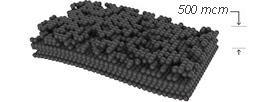 |
 - collection of atoms on the object's surface - collection of atoms on the object's surface |
Under load, wear occurs in the friction zone of the object. Metal atoms are torn away from the surface layer and mixed with the lubricant. In addition, under very heavy loads, entire groups of atoms (clusters) may also break away. This results in significant wear of the component.
2. Application of the Restorative Agent. Beginning of the Restoration Process
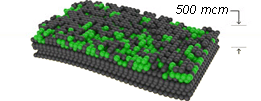 |
| - collection of atoms on the object's surface |
 - collection of metal carbide atoms - collection of metal carbide atoms |
The XADO restorative agent is added to the lubricant and distributed across the friction surfaces of metal parts. When it reaches the friction zone, where excess thermal energy is generated, the restorative agent acts as a catalyst for the formation of a new surface. It activates the carbon absorption process in the surface layer, resulting in the formation of metal carbides.
3. Formation of a New Surface Coating
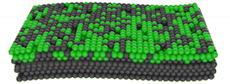 |
| - collection of atoms on the object's surface |
| - collection of metal carbide atoms |
The process of creating a new ultra-strong protective coating takes place thanks to carbides and metal particles that have detached from the working surface but remain suspended in the lubricant.
4. Completion of Surface Transformation
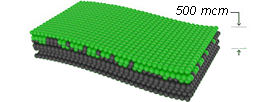 |
| - collection of atoms on the object's surface |
| - collection of metal carbide atoms |
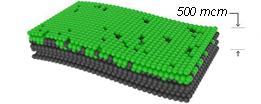
At the final stage, the spread of the protective coating creates a highly durable gradient surface on the metal, characterized by a continuous positive compressive stress.
5. Regular Operation
 |
| - collection of atoms on the object's surface |
| - collection of metal carbide atoms |
As a result of the XADO restoration process, the mechanism receives complete protection against heavy loads, and its service life increases by 2–4 times. The friction pair effectively acquires wear-resistant properties.
Benefits of Using XADO
- Repair and Restoration of Equipment
A new metal-ceramic coating is formed on friction pairs; these parts increase in both size and mass, restoring their original geometry (maximum growth up to 1.5 mm!). Restoration with XADO occurs during normal operation, ensuring a perfect fit of friction pairs. As a result, unit performance increases, operating precision improves, and both noise and vibration are reduced.
- Resource Conservation and Significant Reduction of Equipment Wear
After restoration, the new coating possesses unique properties: exceptional durability (microhardness of 650–750 kg/mm2) and high corrosion resistance. This helps prevent further metal wear, maintain an ideal friction surface, significantly improve equipment reliability, and extend service life.
- Electricity and Energy Savings
Another major advantage of the metal-ceramic coating is its extremely low coefficient of friction (surface roughness Ra up to 0.06 microns). After treatment of friction surfaces, energy consumption can be reduced significantly—by up to 30%.
Restoration Results
The possibility of restoration has transformed the modern understanding of operating and repairing vehicles and machinery. XADO products have laid the foundation for a high-tech yet remarkably simple method of reversing the effects of wear.
As a result of the restoration process, a new coating layer forms on the friction surfaces, the component is restored, and its original geometry is recovered.